
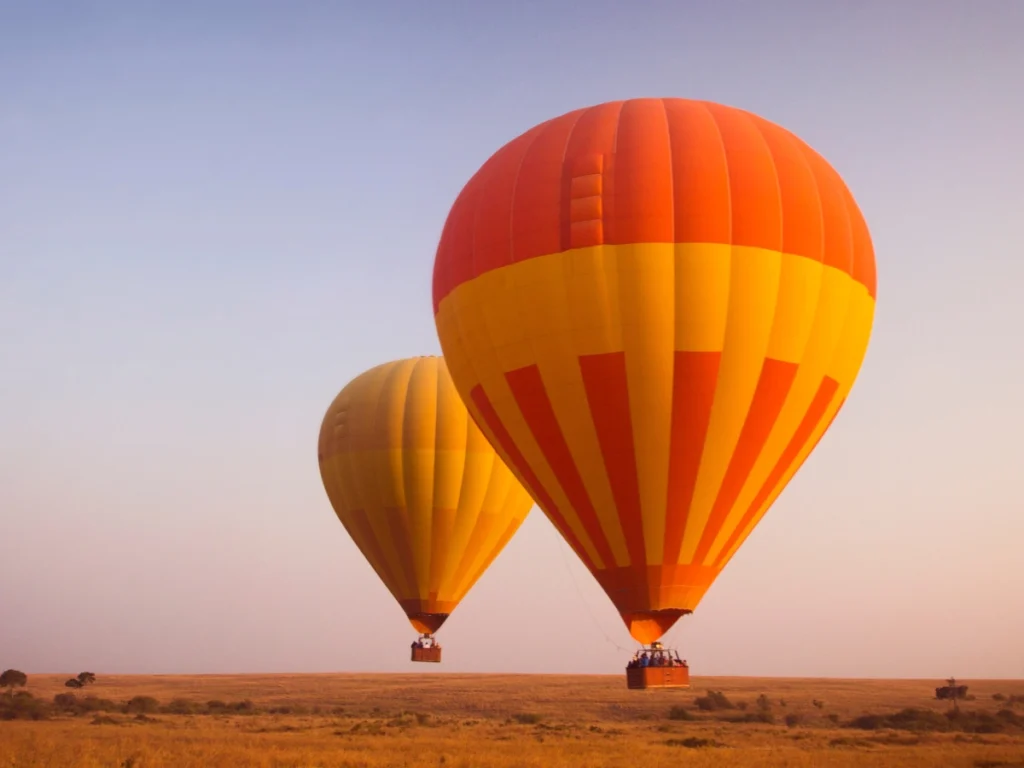
There’s one moment on a Kenya safari that photos never quite manage to capture. Your basket lifts off the grass in total silence, the burner cuts out, and suddenly the whole of the Masai Mara is spread out below you in the first light of morning. That’s a hot air balloon safari in Kenya, and it’s the reason it keeps showing up on every “bucket list Africa” list you’ve ever read.
We put this guide together because most of what’s online about balloon safaris is either a brochure (“magical, unforgettable, once in a lifetime”) or a listicle that never actually tells you what it costs or when to go. Below is what we tell our own travelers when they ask us about booking one: what the morning actually looks like, what you’ll really pay, which launch site to care about, and whether it’s worth the early wake-up call.
What a hot air balloon safari actually is
A balloon safari is a sunrise flight over a game reserve, almost always the Masai Mara, lasting somewhere between 45 minutes and an hour. Unlike a game drive, you’re not chasing sightings from the ground. You’re drifting, sometimes as low as 20 feet over the grass and sometimes over a thousand feet up, watching the rivers and escarpments and wildlife of the Mara turn from grey to gold as the sun comes up.
The pilot controls how high or low you fly by adjusting the burner, but has no control over direction — the balloon simply goes wherever the wind takes it. That’s part of the appeal, honestly: no two flights are ever quite the same. A ground crew tracks the balloon by vehicle the whole way and meets you wherever you land, which is usually followed by a champagne breakfast set up right there in the bush.
We build the balloon safari into our own Masai Mara itineraries rather than treating it as a rushed bolt-on, because it’s a much better experience when you’re not racing straight from the airport into a balloon basket.
Where to fly in Kenya
The Masai Mara National Reserve is the obvious answer, and it’s the right one — the open plains, the river crossings, the sheer density of wildlife make it the best place in the country to see from the air, especially during migration season.
What most first-time visitors don’t realize is that where in the Mara you launch from matters almost as much as when you go. Operators tend to fly out of one of a few general areas: near the Mara Triangle and the Mara River, which is convenient if you’re staying around Governors’ Camp; closer to Talek and Sekenani Gate if your camp is nearer the main entrance; or around Ol Kiombo and Musiara, which tends to shift depending on where the migration herds currently are.
If your camp is a long drive from your operator’s launch site, you’re looking at a 4:00 or 4:15 AM wake-up instead of closer to 5:00 — just for the transfer, before anything else has even started. It’s one of the most common things travelers wish they’d asked about beforehand, and it’s an easy question to ask us or your operator before you book.
Amboseli occasionally offers balloon flights too, with Kilimanjaro in the background, but it’s nowhere near as established or frequent as the Mara.
What actually happens on the morning
Most flights follow roughly the same shape. You’re picked up from camp somewhere between 4:30 and 5:15 AM and driven to the launch site, where you’ll get a safety briefing while the crew inflates the balloon — genuinely worth watching, it’s a bit of a spectacle on its own. Liftoff is timed precisely so you’re airborne right as the sun clears the horizon. The flight itself runs 45 minutes to an hour, drifting over plains, rivers, and whatever wildlife happens to be below.
Landings are controlled but can be a little firm, and the pilot will talk you through the position to brace in beforehand. Once you’re down, there’s usually a full bush breakfast waiting with champagne and a toast for first-timers, plus a signed flight certificate. Most packages wrap up with a game drive back to camp, so the morning ends up doubling as extra wildlife viewing time.
Standard baskets carry up to 16 people split into compartments of four, with the pilot in the middle. A handful of operators also run smaller baskets — four to eight people — for couples or private groups who want a quieter flight.
Best time to go
July through October is peak migration season and gives you the best odds of seeing river crossings and big herds from above. December through March is quieter and greener, with clearer skies and fewer other balloons in the air, though the resident wildlife is still very much there. April and May are the long rains, and flights can get cancelled on short notice — worth booking with some flexibility if you’re traveling then.
Whatever the season, flights only happen at sunrise. That’s not a marketing choice — the air is calmest then, which is what makes safe, stable flight possible.
For a broader look at when to visit, we’ve written a full guide to the best time to travel to Kenya.
What it costs
Budget roughly USD 450–600 per person. Where you land in that range depends on the season (migration months sit at the top), the operator (newer fleets and established launch sites tend to price higher), and whether you’re booking a shared or private balloon.
Most packages include the flight itself, the bush breakfast, transfers to and from camp, and a flight certificate. What’s usually extra is gratuities for the pilot and ground crew (customary at around USD 10–15 per person), professional photography if the operator offers it, and any upgrade to a private balloon.
It’s a genuinely premium experience with real safety and equipment costs behind the price, so we’d be a little cautious of anything advertised well below that range — it’s worth asking what fleet age and safety record you’re actually getting. For help thinking through your wider trip budget, see our Kenya safari cost guide.
Is it actually worth it?
That depends on what you’re going for. If you want a genuinely different perspective on the Mara, or you’re celebrating something — it’s a popular choice for honeymoons — it tends to deliver. The silence and the scale of the landscape from up there are hard to describe until you’ve felt them.
If your main goal is close-up Big Five sightings, though, a ground game drive with a good guide will usually beat what you see from a balloon — altitude and drift mean you’re rarely right on top of the action. Most of our travelers end up doing both: the balloon for the experience, and dedicated game drives for the sightings.
A note on safety
Ballooning in the Mara is a well-established, regulated activity, but operators aren’t all equal. Before you book, it’s fair to ask how old the fleet is and when it was last inspected, how long the pilot has been flying commercially, and what the operator’s policy is if a flight gets cancelled for weather. A good operator will answer all of that without hesitating. We only work with established, licensed operators for exactly this reason.
Questions people usually ask us
How long does the whole thing take? The flight is 45 minutes to an hour, but including pickup, the briefing, and breakfast afterward, plan on about three and a half to four hours from start to finish.
What should you wear? Layers. It can be close to freezing before sunrise in the Mara and warms up fast once the sun’s out. Closed shoes for the landing are a good idea too.
Can kids come? Most operators set a minimum age around six or seven, with children needing to be with an adult. Worth confirming directly with whoever you’re flying with.
Is it safe? Yes, with a licensed and experienced operator. Balloon safaris have been running in the Mara for decades without major incident, and the real-world risk is mostly weather-related, which is exactly why flights are limited to calm sunrise conditions and get postponed rather than pushed through.
Do you need to book ahead? Yes — balloons only carry 16 people per flight, and seats during migration season go fast. Booking it alongside the rest of your Mara stay is the safest way to make sure you get a spot.
What’s the difference between a shared and a private balloon? A shared balloon holds up to 16 people at a lower price per person. A private one, usually four to eight people, costs more but gets you a quieter, more personal flight — a common choice for honeymooners and small groups.
Planning your own balloon safari
A balloon safari is at its best as part of a proper Masai Mara stay rather than something squeezed into a single rushed day. We build it into itineraries like our 3-Day Fly-In Masai Mara Safari and our 5-Day Kenya Honeymoon Safari, or we can work it into a tailor-made itinerary built around your own dates and budget.